

Craps is a dice table game built around the shooter, come-out roll, point numbers, and wagers settled by later rolls. Bangladeshi readers benefit from understanding the betting sequence before exploring the many choices displayed across the table. EG33 is the supplied online betting platform, without assuming unverified game availability, limits, promotions, or regulatory status.
Understanding craps table layout and basic mechanics
A standard craps table groups wagers into labelled zones associated with different dice outcomes and stages of a round. Learning these areas makes later betting decisions easier to follow.
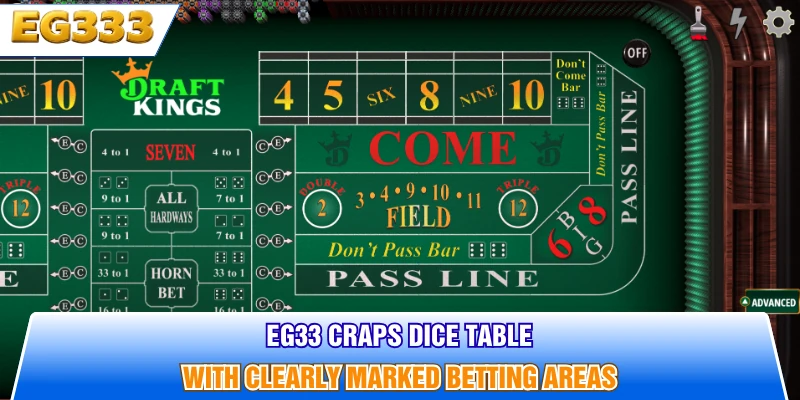
The role of the shooter and the come-out roll
The shooter rolls two dice, while the come-out roll begins a new betting cycle and determines whether a point becomes established. On a come-out roll, Pass Line wagers win with seven or eleven and lose with two, three, or twelve. If four, five, six, eight, nine, or ten appears, that number becomes the point for the active round.
The shooter continues rolling until the point repeats for a Pass Line win or seven appears for a loss. Understanding this sequence helps craps players interpret results without treating every dice outcome as an entirely separate event.
Pass line and don’t pass line bets explained
A Pass Line bet follows the shooter, paying even money when the come-out roll produces seven or eleven. It loses immediately on two, three, or twelve, while any point number moves the wager into the point phase. A Don’t Pass bet largely takes the opposite position, winning on two or three and losing on seven or eleven.
Twelve normally pushes the Don’t Pass wager, while an established point changes which subsequent result settles the bet. These opposing structures make craps line wagers useful foundations for understanding longer-running bets and table mechanics.
House edge and payout breakdown
House edge represents the casino’s mathematical advantage over repeated wagering rather than predicting one short session’s outcome. Line bets have relatively low built-in edges, while free odds are paid according to true mathematical odds. Players should compare both house edge and payout structure before deciding how much bankroll to expose.
| Bet type | House edge | Payout / true odds |
| Pass Line | 1.41% | 1:1; odds 2:1 on 4/10, 3:2 on 5/9, 6:5 on 6/8 |
| Don’t Pass | 1.36% | 1:1; lay odds reverse Pass Line odds |
| Come | 1.41% | 1:1; odds follow the come point |
| Don’t Come | 1.36% | 1:1; lay odds follow the come point |
| Free odds | 0% | Paid at true odds according to point |
Intermediate betting options for table game players
Once line mechanics are familiar, intermediate wagers allow participation in additional number cycles during an active point. These choices can increase total money exposed without changing the randomness of dice results. In craps, knowing exactly when each wager begins and ends remains essential.

Come bets and don’t come bets
A Come bet resembles a new Pass Line wager placed after the table already has an established point. Its first roll wins on seven or eleven, loses on two, three, or twelve, and otherwise creates another point. That wager then wins if its number repeats before seven, even while the original table point remains active.
A Don’t Come wager largely reverses that structure, with two or three winning, seven or eleven losing, and twelve pushing. Using craps Come wagers can spread action across numbers, but simultaneous positions also increase the bankroll committed during each roll.
Taking and laying odds for better returns
After a Pass Line or Come point is established, taking odds adds another wager behind the original bet. Because this portion has no house edge, combining odds with a line wager lowers the blended edge on total money staked. Don’t Pass and Don’t Come players may instead lay odds, risking more because seven is favoured over each individual point.
Casinos can impose different odds limits, so players should check displayed rules rather than assume a particular multiple. In craps, odds improve mathematical value on qualifying wagers, but increased exposure can still create larger bankroll swings.
Smarter strategies to play with confidence
No betting pattern controls independent dice outcomes, so sensible strategy focuses on wager selection, exposure, and disciplined session management. Lower-edge choices can reduce expected cost but cannot eliminate variance or guarantee profits. For craps players using BDT budgets, predetermined limits can support clearer decisions during fast gameplay.

The 3-point Molly strategy for beginners
The 3-Point Molly generally begins with a Pass Line wager, followed by odds after a point becomes established. The player then makes Come bets and adds odds when those wagers move onto individual numbers. This approach seeks action on up to three point numbers rather than continuously creating additional positions.
A seven can clear several active wagers together, meaning the method still carries substantial downside despite using efficient bets. Beginners studying craps should view this system as structured bet management rather than a method for overcoming random outcomes.
High-risk bets to avoid at the table
Proposition wagers often display attractive payouts, but many carry considerably higher house edges than basic line bets. Hardways, Any Seven, and specific one-roll combinations are examples where payout size must be considered alongside probability. Frequent proposition betting can increase the expected cost of a craps session despite occasional individual wins appearing substantial. Comparing house edge, payout rules, and settlement speed provides a clearer picture of each wager’s underlying risk.
Proper etiquette and bankroll control
Table etiquette keeps gameplay orderly, while bankroll limits help prevent rapid rolls from encouraging impulsive stake increases. Any BDT budget should represent disposable entertainment money rather than funds required for essential expenses.
- Keep chips and hands clear while dice are being thrown, and follow table instructions regarding when wagers may be placed or changed.
- Set a fixed session budget beforehand, such as a hypothetical BDT 2,000 allowance, without treating losses as money that must be recovered.
- Maintain manageable stake sizes instead of sharply increasing bets after losses, because previous outcomes provide no guarantee about subsequent rolls.
- Check wager positions carefully on compact smartphone interfaces, where crowded controls can make unintended selections easier during fast-paced gameplay.
- Stop when the predetermined budget or time limit is reached, regardless of recent results or expectations about the next dice outcome.
Conclusion
Craps becomes easier to understand when players learn the come-out sequence, line bets, Come wagers, odds, and relative costs of different choices. True-odds additions improve the mathematical value of eligible wagers, whereas high-edge propositions generally increase expected playing costs. EG33 should receive the same approach as any betting platform, verify current rules and treat wagering as entertainment involving financial risk.